Lunologium · Annual almanac
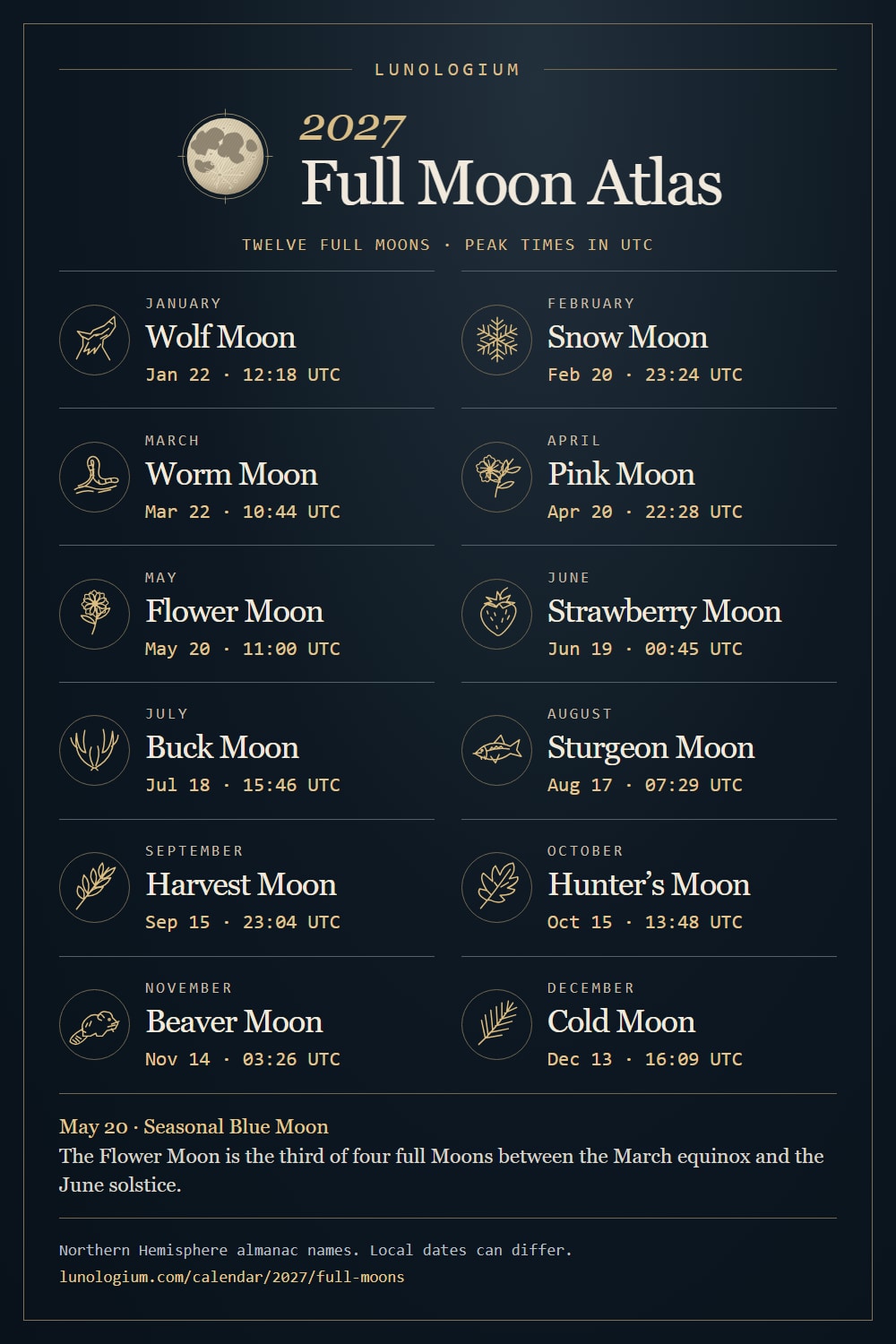
2027 Full Moon Atlas
Find all 12 full Moon dates, peak times and the stories behind their names.
The year in full Moons
Dates & times in UTC01 / January
Wolf Moon
A wolf’s midwinter howl gives January its almanac name.
02 / February
Snow Moon
Heavy February snow in parts of North America lends this Moon its name.
03 / March
Worm Moon
Accounts differ: some point to earthworms in thawing soil, others to larvae emerging from bark.
04 / April
Pink Moon
The pink belongs to spring wildflowers, not to the Moon’s surface.
05 / May
Flower Moon
May’s name looks to the abundance of flowers in spring. This year it is also a seasonal Blue Moon.
06 / June
Strawberry Moon
This name marks the early summer strawberry harvest in North America.
07 / July
Buck Moon
The season’s emblem is a buck growing a new set of antlers.
08 / August
Sturgeon Moon
August’s name recalls the lake sturgeon fisheries of the Great Lakes.
09 / September
Harvest Moon
September 15 is the full Moon nearest the September equinox in 2027.
10 / October
Hunter’s Moon
The Moon after Harvest takes its name from the hunting season.
11 / November
Beaver Moon
Accounts point to beavers preparing for winter or to the season for setting traps.
12 / December
Cold Moon
December’s name marks the approach of winter in the north.
About the names. These are common Northern Hemisphere almanac names. Traditions vary by community and region. Seasonal notes draw on Royal Museums Greenwich and The Old Farmer’s Almanac.
About the times. Astronomy Engine calculates the full-Moon instant. Times are rounded to the nearest minute. Names follow the UTC calendar. Your local date can differ. All twelve UTC dates agree with the U.S. Naval Observatory’s 2027 phase table. The rounded times differ by at most one minute.
When can I see the full Moon? The peak is one instant worldwide. The Strawberry Moon peaks at 00:45 UTC on June 19, which is 5:45 p.m. on June 18 in Phoenix. For a time to look outside, check moonrise for your location.
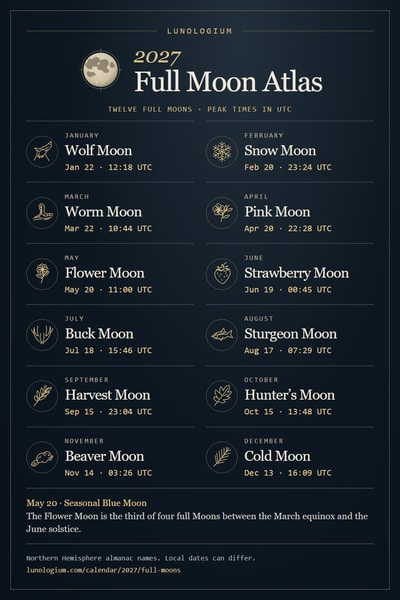
Save the 2027 atlas
Keep all twelve Moon names and UTC times together on one illustrated poster.