Lunar Sample Atlas
Interactive petrology, photomicrographs, mineral assemblages, and radiometric isochron ages for 382.4 kg of returned Moon rocks curated at NASA Johnson Space Center.
PETROLOGIA · GUIDED SPECIMEN READING
A rock is a timestamp.
Follow one returned specimen from lunar ground to mineral texture to the age that changed the Moon’s history.
01 · FIELD CONTEXT
A rock begins as a coordinate.
Before it becomes a number in a catalog, a lunar sample is a place, a mission, and a moment of collection. The landing site is the first line of its provenance.
Geological reading
The definitive physical evidence for the Lunar Magma Ocean hypothesis—a relic of the primordial crust that floated to the top of a molten Moon 4.
The definitive physical evidence for the Lunar Magma Ocean hypothesis—a relic of the primordial crust that floated to the top of a molten Moon 4.5 billion years ago.
The selected specimen drives the provenance chain, mineral field, mass, and isotopic position.
Fragments of another world.
Petrology, radiometric isochron ages, and thin sections for curated lunar rock specimens brought to Earth.
Genesis Rock
Apollo 15
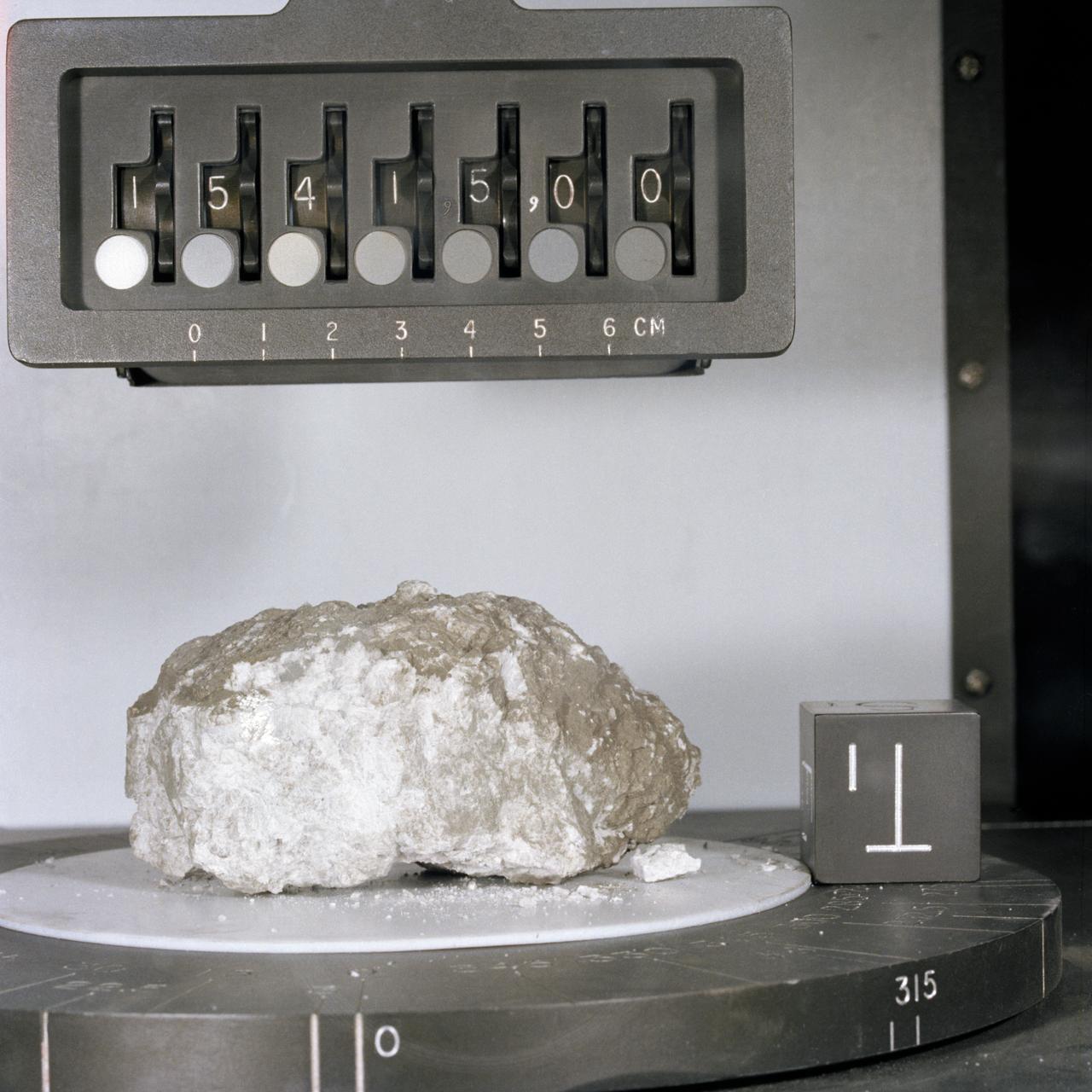
Sample 15415 in the Lunar Receiving Laboratory after its return aboard Apollo 15.
NASA · NASA Image and Video LibraryThe definitive physical evidence for the Lunar Magma Ocean hypothesis—a relic of the primordial crust that floated to the top of a molten Moon 4.5 billion years ago.
Granulitic anorthosite composed almost entirely of calcic plagioclase with complex deformation twinning and shock fractures.